Cost of quality
Or Thing-I-wish-I-knew-15-years ago #2
As a UX researcher, and a qualitative researcher, I am forever trying to defend why observing even 5 people is beneficial, why design improvements matter, how usability contributes to the bottomline, etc. (I'm just fortunate to be working for a startup where the product leaders are design-mature, and I never needed to explain this to them in the past 4 years)
Enter, my Operations Management class. [Thank you, Les!]
On Week 1, basically, the intro week, I learned how to do a check-sheet.
(Let me also give a disclaimer, I've been doing feature prioritization based on discovery research since 2011, but I come from the IDEO-and-37-Signals school of interaction design, and not the W.E. Deming school of process analysis – though I'm a fan).
What are check-sheets?
Check sheets (should) form the foundation of functional process maps. And, the proper definition is that that list contains all the tasks customers care about*.
And, this is one of the "-cons" of getting more mature or tenured, right. At some point, things become second nature and you can forget to articulate the rigor to yourself.
This lesson reminded me of how meticulously I used to document user tasks and job stories.
- And, I loved it. A third of why I even took the program that I did is because I realized that I needed to get a good grasp of Operations Management, if I wanted to continue down the path of service design.
- I also happen to like working for "boring" systems. Hence, my last two jobs were at a bank (where I was most excited to digitalize branch and HR systems) and freight (where I work on process automation for accounting and operations teams). Whee!

How would I apply this?
One direct way I've applied it is in doing user journeys, or identifying priority processes to meet business goals.
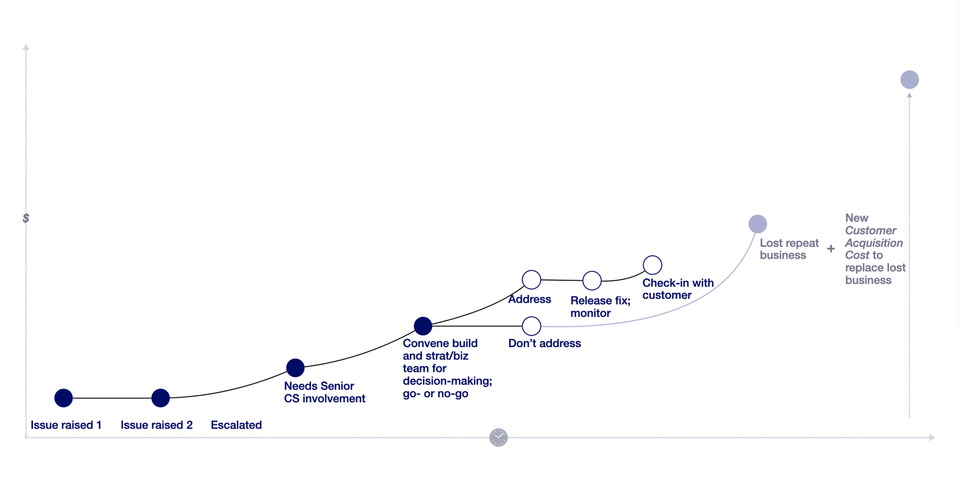
For example, if you can identify that there's a certain threshold or class of customer complaints that leads to churn, you can infer the resulting opportunity cost of the cause.
(I like being part of building and "sustaining" digital products, because you get to develop a sort of muscle memory for things like this):
- At some point, you gain the evidence to determine that after, say, approximately 3 feature complaints (or 2 failed attempts at looking for something; or waiting for ~20 seconds), a customer will start to churn. It can be behavioural churn, meaning they just stop coming back.
- You can use the ratio above to calculate the cost of sustained usage (Acquisition Cost / 5 = Satisfaction Cost versus the total "Dissatisfaction cost").
- And, this is fair math. Now, say, you've lost the customer - and if that's a paying B2B customer, let's say the impact is $1,000 per month.
- This especially hurts for B2B, but you know what, for niche B2C, this is pretty hard, too. Now you have to deploy resources to recover that lost $12,000 annual, and likely wait 3-9 months for the sales cycle to bear fruit.
- Not including the cost of customer support and appeasing an irate customer, and possible downstream resources needed for issue resolution (e.g. developer time, product manager, senior CX/CS person, design time, QA, project manager/ scrum master).
- ...When you could have just fixed that feature.
"So if they fix that, will it make people come back?" report-after-report...
*This is also similar to Gerry McGovern's Top Tasks identification (which I do an abridged version of, since the total survey process is...intense).
Going back.
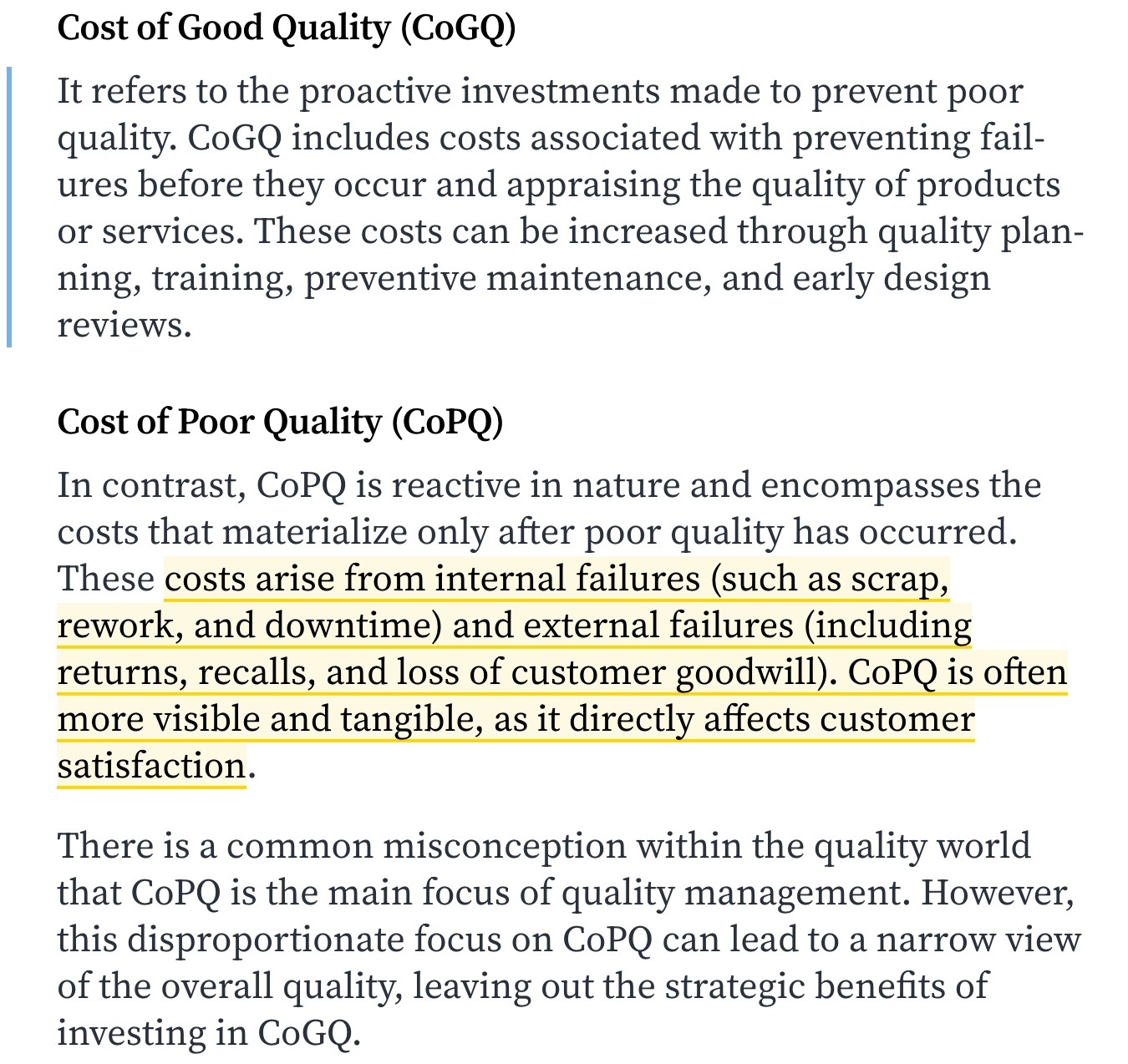
I wish I learned this quantification years ago, because it was always a challenge to explain the ROI of usability or design improvement.
I've had to literally pull people into usability tests, so that they – IT, Legal, Product, Design people – would realize we need to change something. Maybe putting a dollar amount would have been faster. (Though, at least they also built empathy and had an actual appreciation of the user experience, through watching in-person usability tests.)
I've also been part of teams where we developed and released glaring errors, and – yes, that's human – but also there was no clear or expressed cost around the customer service and support it would take to recover the customer impact of those errors.
I loved the check sheet lesson because it gave a codified process to the discovery-and-prioritization approach I did, even if it came from an adjacent field.
For example: I did do Pareto analysis (this was THE most effective way to filter through 40+ user stories or feature), but I didn't realize there was a standard way to do it in Excel 😆
 AlexJerabek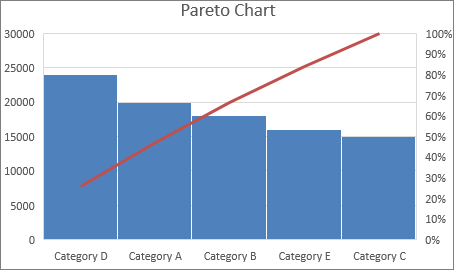
All this to say - thanks, Les. And, the Operations Management book we used, for teaching this human-centered-design dog, new quality management tricks.
Written, in June 2025.