On Liberal Institutions...
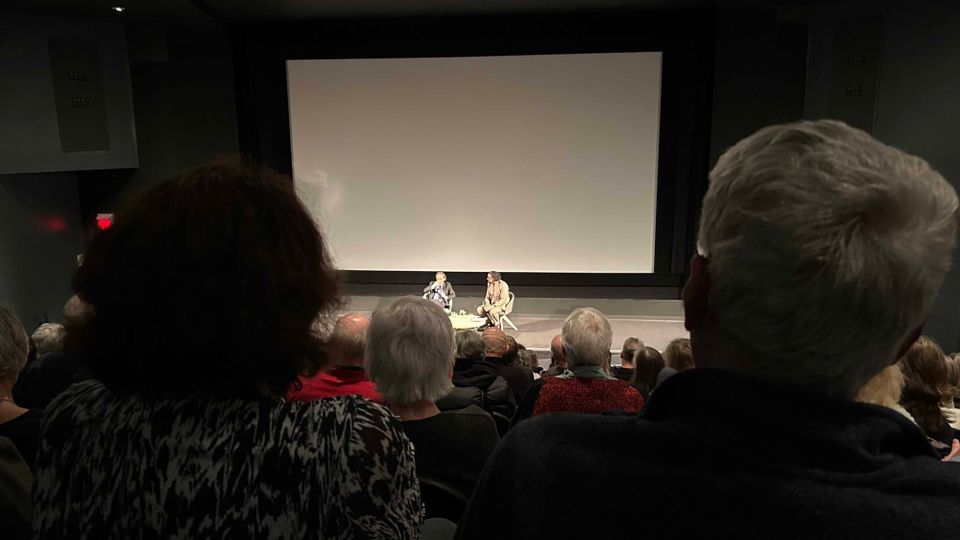
Adam Gopnik's talk and book signing for SFU Liberal Studies
This particular one is still organized by a university, and a university-driven organization, but just the fact that it's on Eventbrite and anyone can actually sign up -- for free... I'm just grateful for these, and I will happily sign up for each talk that I'm interested in, when my schedule permits.
I went to was SFU Public Square's interview with Adam Gopnik on Liberalism, as he had just published a book entitled A Thousand Small Sanities.
The most mind-blowing thing for me that evening: What do you think a liberal democracy relies on? Yes, free elections. Yes, an educated voting population*.
But, I never thought that part of the answer was...coffee shops.
Gopnik shared that effective liberal democracies need two things: fair and free elections, and open (liberal) institutions.
What are open institutions? Universities, yes. Public libraries, yes. These are formal institutions.
But, also: any space that allows us to be with and talk freely with others - learn the realities of our society, across classes (or hierarchical social groups). Informal open institutions.
- Spaces like... parks, coffee houses (he mentioned the traditional European street-side coffee house, not fancy ones with a high barrier to entry), and theatres (again, without too much of a financial barrier to entry)***.
- He did mention that one predictor in olden times of a country adopting democracy, was an increase in amateur opera groups (a European example, of course).
- Basically, having spaces where people could come together, maybe randomly strike up a conversation about each other's life or interests, without necessarily talking about political things.
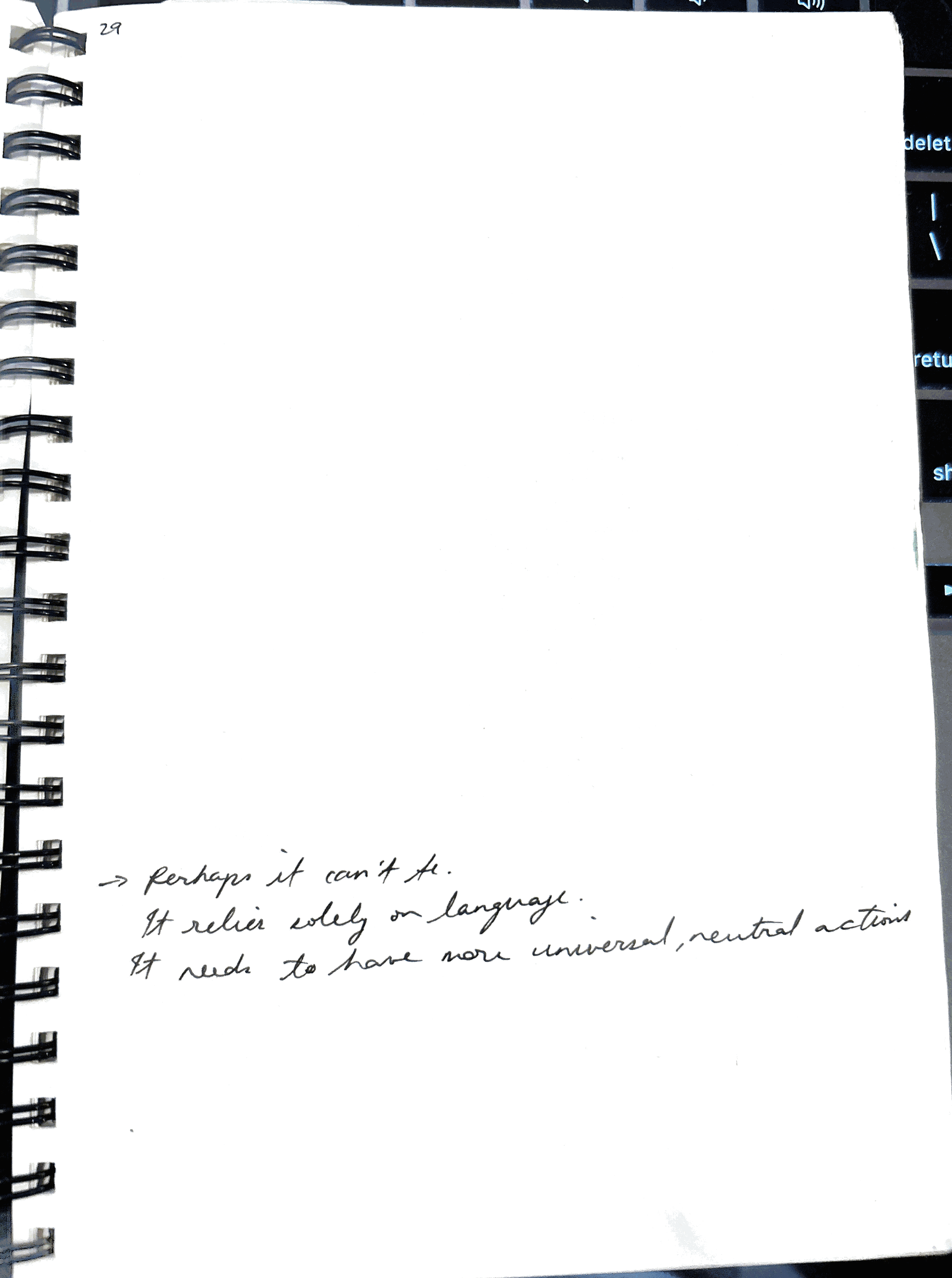
I'll post my full notes from the event, but for now, just sharing my favourite takeaway from the event. The main question I kept asking myself throughout the event: How can the Internet go back to being an open institution? (This includes not being profit-driven, and genuinely caring about societal welfare)
*This I picked up from Yahra's book -
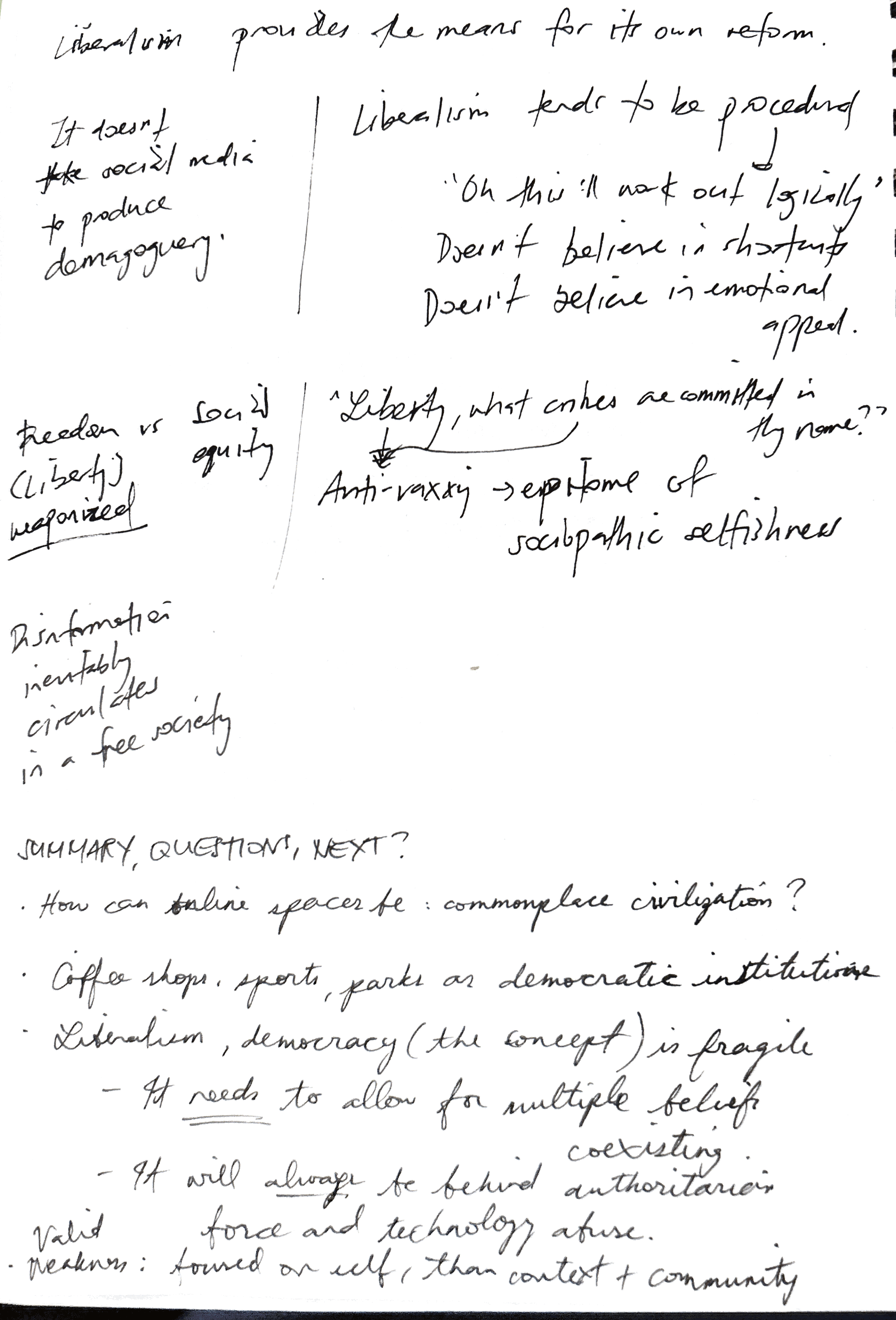
**Liberalism – as he describes it is about two things: individual liberty and social equality. Basically, you believe you value being free, but that means you also value that everyone is free to be (in a way that doesn't harm others. Adding that in case I needed to be very clear). He even emphasized at the end of his talk - that believing in people's freedom includes societal care, because you still shouldn't use freedom as an excuse to sociopathically harm others.
'*** It's not lost on me that these aren't common in Manila. The counterpart of a liberal institution in Manila would then be...malls. Open to the public, and all walks of life.
Raw Notes
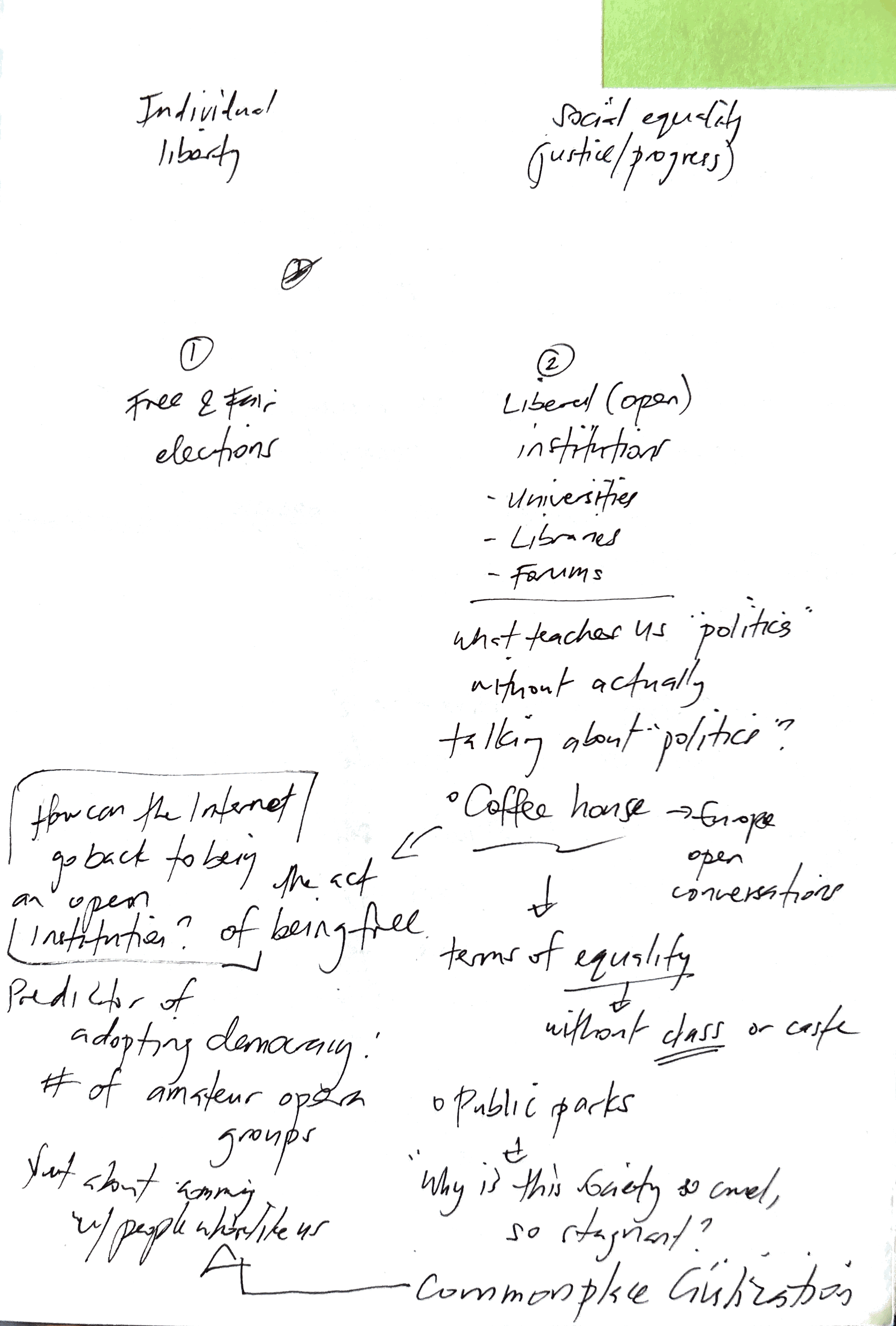
- Liberalism is about: BOTH Individual liberty and Social equity
- You cannot value your own freedom, without wanting that same individual freedom...for all.
- Basically, the fact that you think you deserve to be free assumes that everyone has that same right, and you want both of those at the same time.
- Liberalism relies on two things:
- Free and fair elections
- Liberal (open) institutions
- What are examples of liberal institutions?
- Universities
- Libraries
- Forums
- Also: "What teaches us about politics without actually talking about politics?"
- "Commonplace civilization": Not about community with people who are like us
- Coffee houses (Europe: Open conversations)
- Terms of equality: without class or caste
- Public parks
- He sometimes finds himself asking "Why is this society so cruel, so stagnant?" (And, I will guess this is connected to the lack of parks)
- Coffee houses (Europe: Open conversations)
- "Commonplace civilization": Not about community with people who are like us
Predictor of adopting democracy: # of amateur opera groups
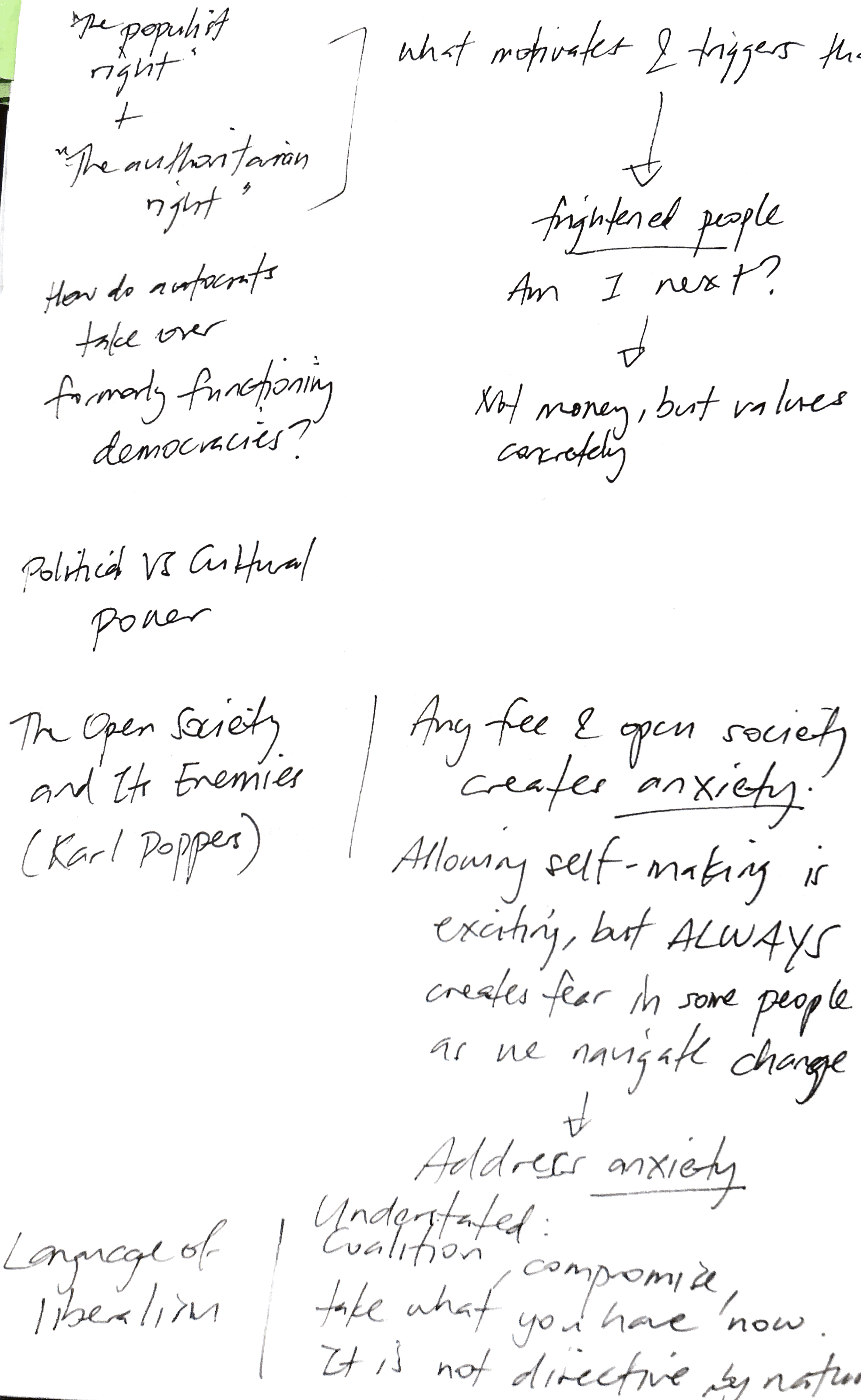
Populist "right" and Authoritarian "right" -> What motivates and triggers this?
Frightened people -> The thought of "Am I next?"
How do autocrats take over formerly functioning democracies? Political VS Cultural power.
Any free and open society creates anxiety.
Liberalism, the allowing of "self-making is exciting[,] ALWAYS creates fear in some people as we navigate change."
[How to help, for better or for worse, since this can be taken advantage of by autocrats:] Appease anxiety.
Liberalism tends to lose, because...
Liberalism is not directive, by nature.
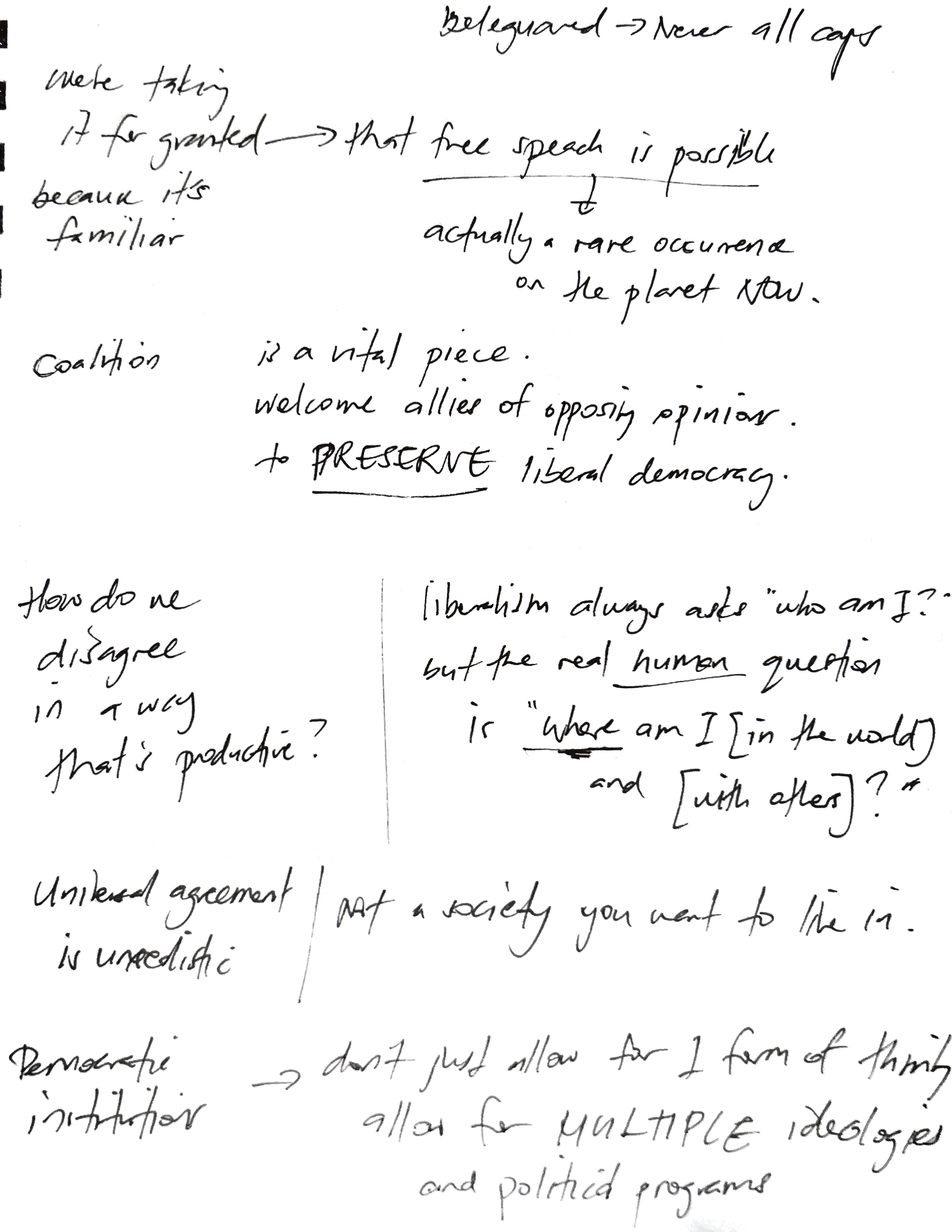
- It's about coalition, compromise. Understated, beleaguered, never "ALL CAPS".
We're taking it for granted... that free speech is possible, because it's familiar. Even if free speech is a rare occurrence now, compared to before.
Coalition is a vital piece. Welcoming allies of opposing opinions.